

Dela Anyah is transforming the way we look at tires.
Anyah is a Ghanaian multidisciplinary artist who transforms discarded tires and inner tubes, license plates and bicycle rims into sculptural installations, exploring themes around value, sustainability, identity, material reuse and cultural narratives.
Breathing new life from decay, his pieces represent stories and dialogue challenging viewers of notions of value and beauty.
“My practice reimagines waste as a resource, centering on the afterlives of the tire industry,” he writes. Through weaving discarded inner tubes and mapping tire and repair networks, I examine how waste circulates between local economies and global systems. These transformations render overlooked materials into forms that reveal the intimate links between daily discard and planetary warming.
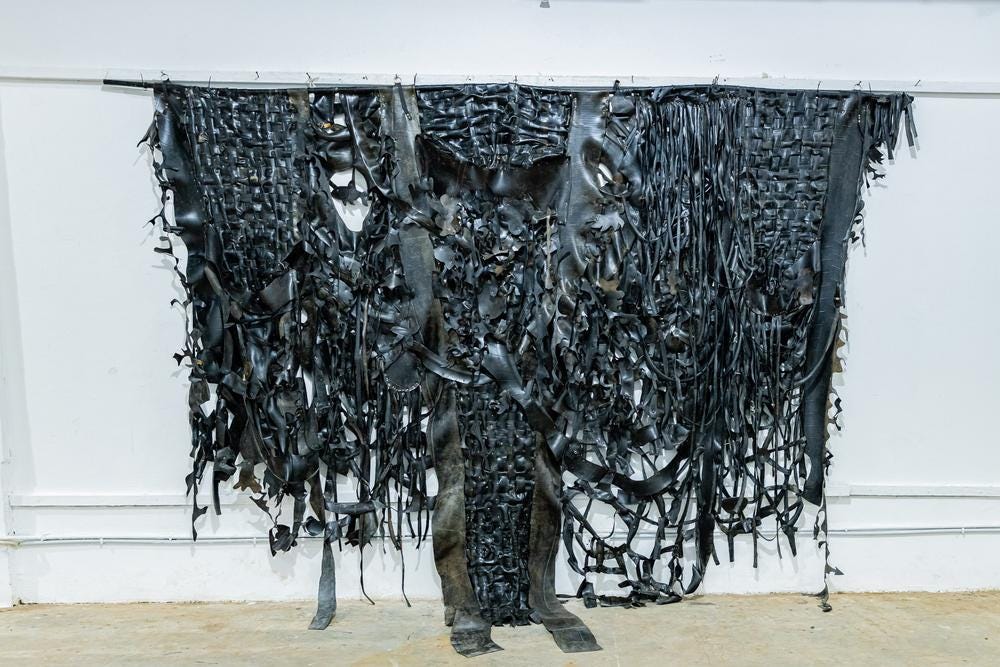
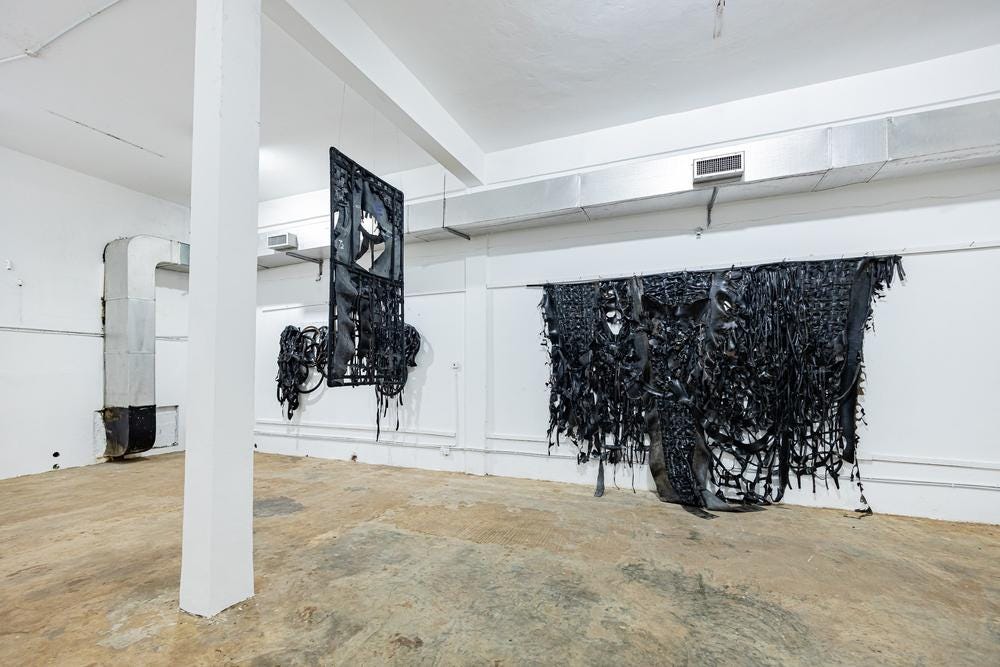
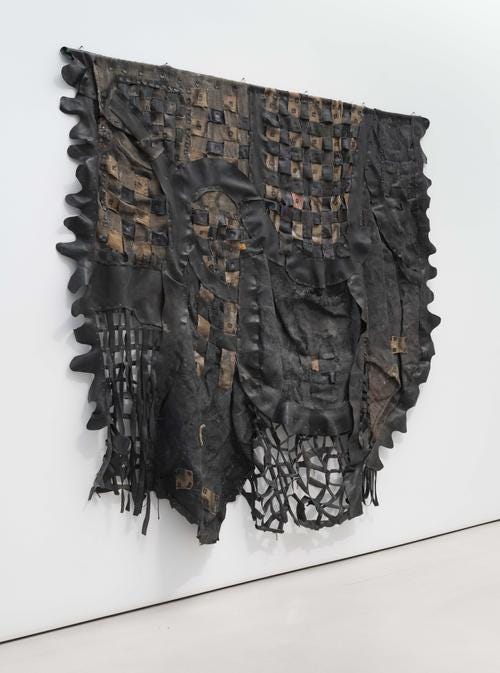
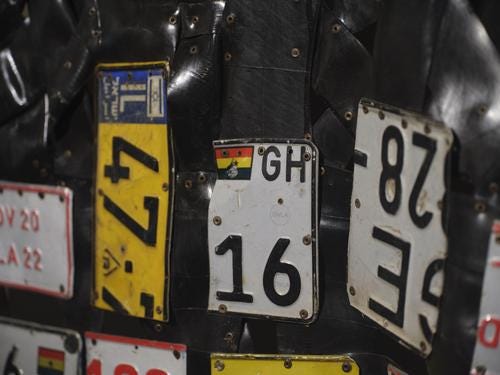
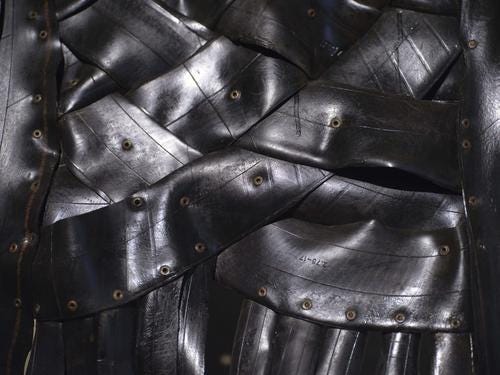
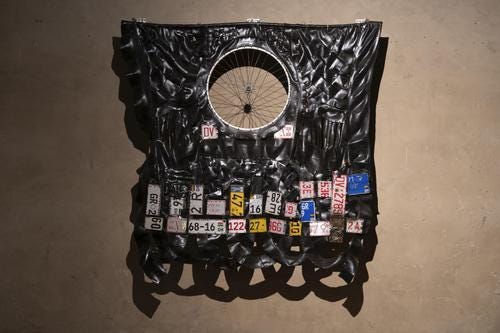
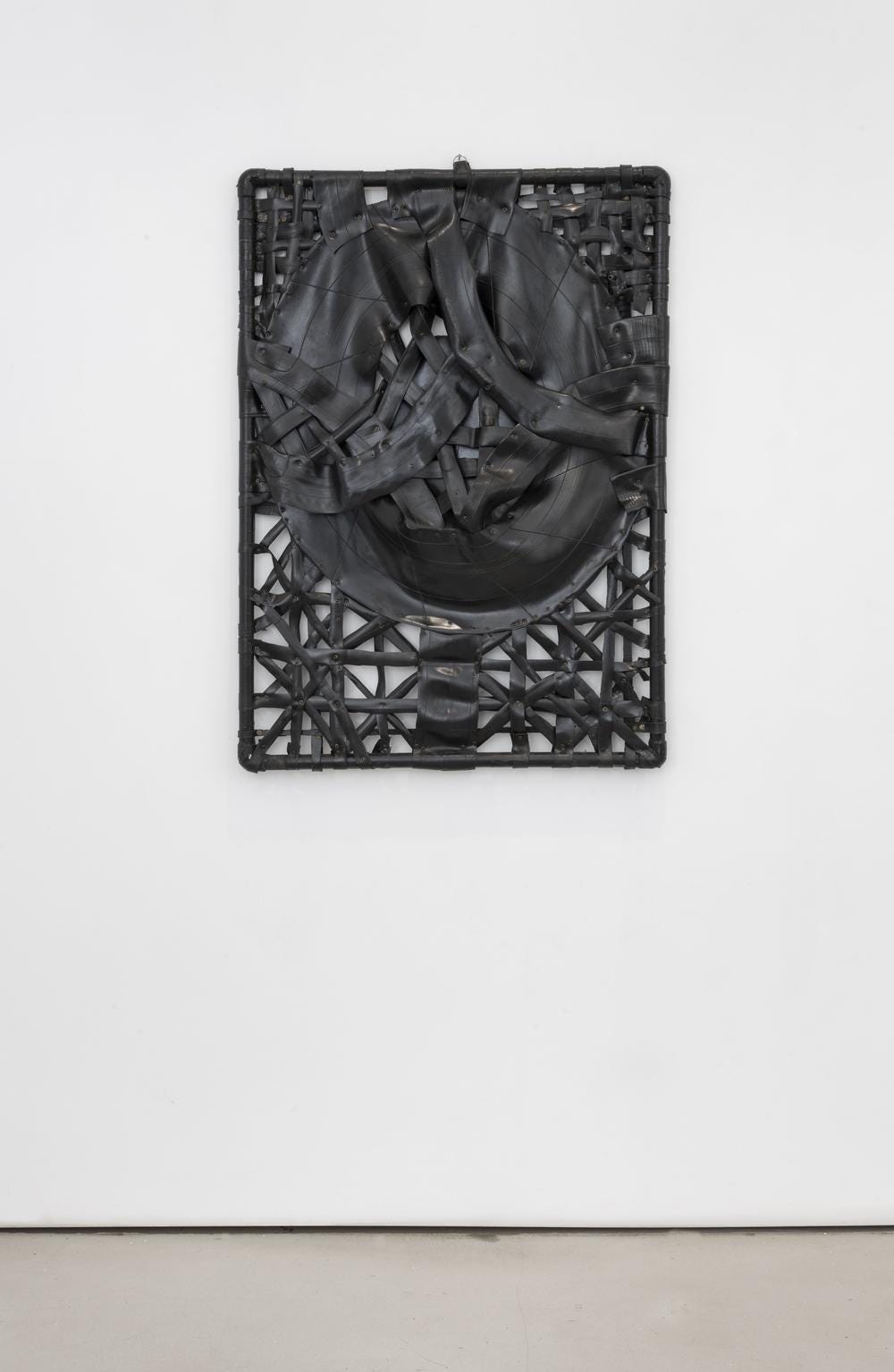
Often magnificent in size, his installations resemble textile-like tapestries, mimicking similar features of warrior cloths, reminiscent of garments worn in tribes. These cultural features make sense, as he incorporates ancestral weaving techniques into the practice, paying homage to the cloths historically woven in the various regions of Ghana. With identifiable items like bike wheels and license plates to signal its origins, the rubber tire is expertly cut, patched, woven or bolted into draping sculptures that demand your attention.
In one show Dela presented halves of tires firmly rooted into the ground as if partially buried. In another, his tapestries have integrated jute sacks- also a waste resource, into the visual composition, exuding a rugged yet cohesive craftsmanship that clearly took time and concentrated intention.
Some pieces present the shiny rubber material expertly braided and tucked away firmly in the inside of a wheel, while others the textile-like installation consuming it. The bolts give it a raw, industrious look indicating its urban conception.
Thoughcompletely transformed, the material and its parts are identifiable to the viewer as everyday items, striking a chord of familiarity, proceeding with an astonishment at its transfiguration.
While Anyah uses urban materials, the visual works embody a down-to-earth, natural aesthetic. Maybe it’s the grit and toned-down earthiness of its palette, or maybe it’s the strong environmental messaging that serves as a central theme of his projects, the very foundation of each installation.
According to Dela’s findings, 29 million tires are discarded in Ghana every year. Globally, that figure is over 1 billion.
“Tire waste, in particular inner tubes and bicycle tires are usually burned by vulcanisers which produce toxins in the environment. This poses various concerns like global warming and health issues to those who breathe in that thick black smoke mostly containing carbon monoxide, sulfur dioxide amongst others,” he writes on his Instagram. “And there is the breeding of mosquitoes as well in the water that gets trapped in tires accumulated around the city.”
Beyond the ecological concern, the artist aims to investigate other angles of this industrious sector of mechanical car repair that often go unnoticed. He insists on highlighting the labour involved; The humanity of this work and its importance in West African society.
Dela has documented countless repair shops commonly known in Ghana as “vulcanisers” to foster conversation on socio-cultural ecosystems and how these establishments slowly vanish into obsolescence. By photographing and mapping these shops around West Africa, the data becomes a record of presence, pointing to how informal spaces of repair continuously negotiate belonging, visibility, and permanence within unstable urban and economic systems. He tracks their migration as disputes with land owners and governmental impede their existence. He’s witnessed this erasure with evictions from highway expansions and new developments in the urban landscape.
“The Vulcaniser Archive is a photographic research project basically documenting Vulcaniser shops within Ghana first and other places within the region,” he writes. “Mapping their migration, labor and architecture.”
“It started after observing the erasure of shops due to road expansions on major highways. “Some shops within the archive no longer exist but that’s the point of its creation, the archive then becomes a proof of their existence.”
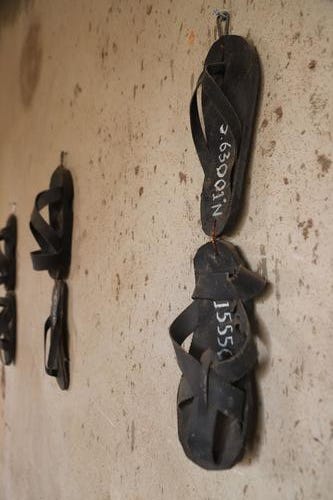
Taking it a step further, Anyah’s project “Homecoming” brings his study to the field not just in the form of research but rather as a centre stage of performance, presenting the source of his inspiration as an exhibition space. Hanging up his intricately bound installations in these mechanic shops, he utilises these informal settings to showcase the final product right next to the source. He stresses not only the precarity of these spaces, but the importance of having those within the sector interact with the material they are so familiar with, now remodelled in a reimagined creative form.
“This was the very shop where I had purchased the inner tubes used in the work. Returning to the origin and fostering a dialogue with the shop owner speaks to the potential embedded in objects we often deem waste, and the impact of discarding or burning them. Homecoming also explores the idea of a vulcaniser shop as an exhibition space, and what it means for the community to engage with art within familiar spaces that resonate with the material itself.”
Over the years, Anyah’s work has steadily become recognized by the art world. He completed the widely known Noldorr residency in 2023 and has been part of multiple group shows at the Nubuke foundation, located in the East Legon neighbourhood of Accra. But he is now resonating with audiences beyond Ghana’s borders.
He was the finalist in the prestigious Elipse prize and the artist recently came back from working on one of his biggest projects so far at the Biennale Internationale de Sculpture de Ouagadougou as a presenting artist. BISO is the first major recurring biennale dedicated entirely to contemporary sculpture on the African continent.
Located in the heart of Burkina Faso’s capital, artists work on their craft on site, with a culminating exhibition representing these artists’ sculptural works. This edition’s theme was “Unbearable borders”.
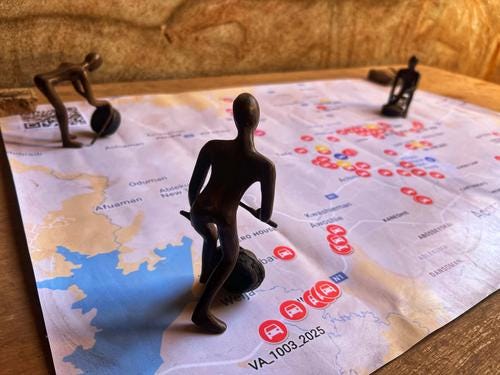
Anyah presented his archive in the format of a photo installation with maps and videography to demonstrate the geographical placement of the informal establishments throughout Western Africa, indicated by GPS coordinates. “This installation draws from shops in Ashiyie and Dome (Two suburbs in the Greater Accra Region), highlighting how they relocated when governments or original landowners began new construction on their plots.”
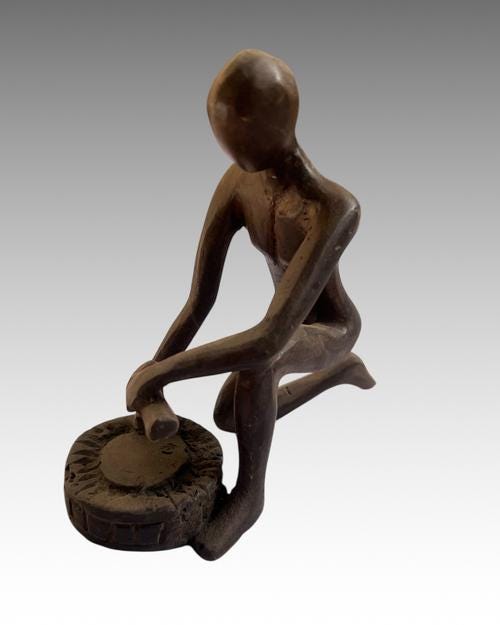
It was during the residency that Anyah began working with bronze, creating figurines of the workers at these tire shops. “The bronze works basically capture the labor of vulcanisers in different poses, speaking to what they do and how important their labor is to keeps vehicles on our streets moving everyday.” he writes.
With no formal training, Anyah describes himself to be a self-taught artist not limited to titles or boundaries of specific mediums. His work that spans so many formats clearly demonstrates he is achieving just that.
He recounts to me how the inception of his body of work started in 2019, after regularly constructing bikes as a hobby, being surrounded by these inner tubes. He recalls one day drawing a sketch. “I didn’t pay much attention until 2020 where I had this sketch of tire sculptures, I don’t know where it came from. I don’t know if that was the inspiration.”
He explains that his processes have been intuitive and are fuelled by the passion he has for his project.
“Art is something I’ve always loved to do. When I think of what I do now, I think it’s rooted in things I was doing when I was young, in my childhood. My mom used to have a fashion studio where I used to cut different materials and try to create stuff out of fabrics that were found over there. My dad also had a hostel, and I used to go to a lab, taking objects and various things. So I think I’ve always just been creating out of the objects that I find around me.”
You can find Dela’s work on his website and Instagram.”